The World Was Built by Delusional Optimists
Optimism isn't naïve, it's essential. It's the belief that the future can be better and that we have the power to make it so. Every product I admire — the iPhone, SpaceX rockets, ChatGPT — was born from unreasonable optimism.

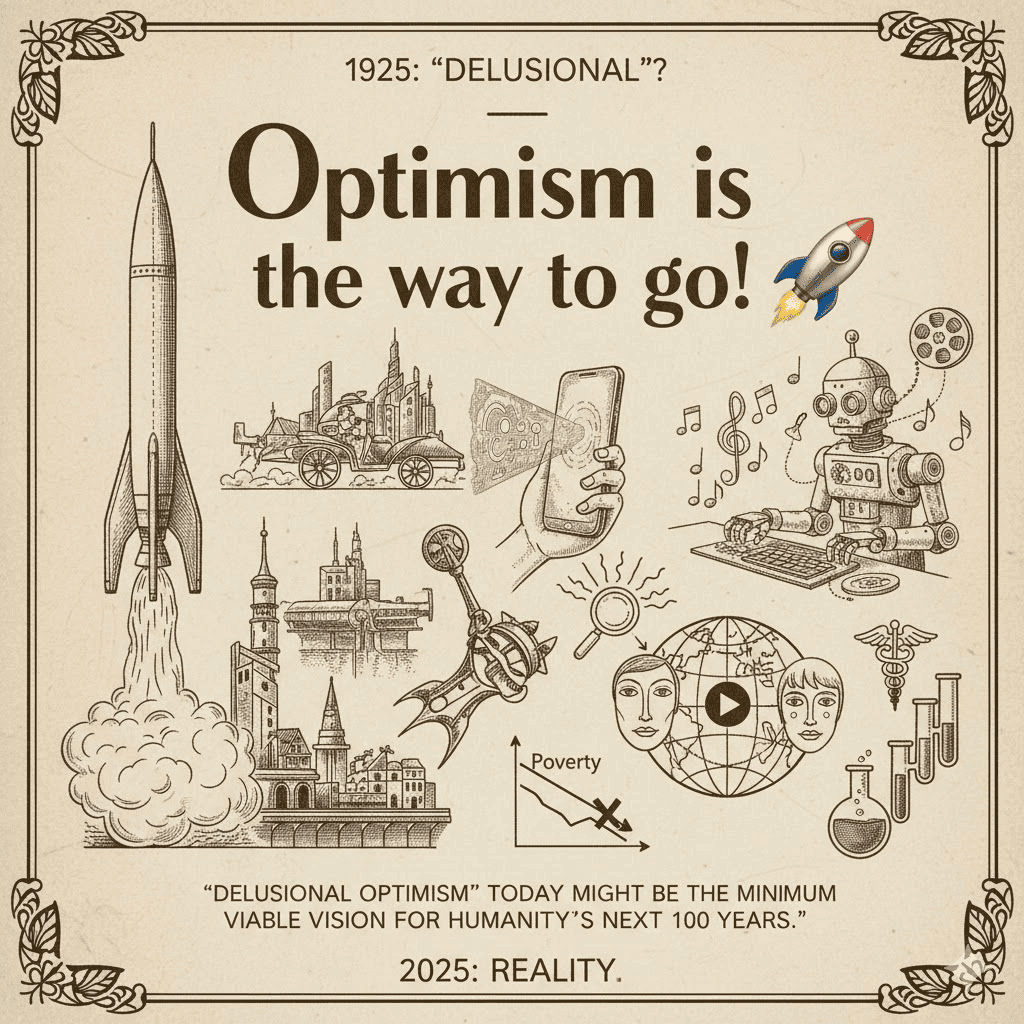
Imagine telling someone in 1925 that a 100 years later:
- Rockets that land themselves
- Cars that drive themselves
- Phones smarter than geniuses
- AI that builds products, generates music, films, and text
- Search information globally in real-time
- Global video calls, for free
- Reduce global poverty by 90%
- Treatment for most known diseases
They'd probably laugh, call you delusional, or lock you up for being too imaginative.
And yet, here we are in 2025, living in a world where the impossible has become ordinary.
It's wild to think about, right?
Every breakthrough we now take for granted was once seen as madness.
That's why I've come to believe optimism isn't naïve, it's essential.
As a founder, I've learned that pessimism never built a company or changed the world.
It's optimism that turns what if into what's next.
Whenever I share a new idea, especially something that doesn't exist yet, I often get that polite smile that says, “Good luck with that.”
It used to sting. Now, I take it as a sign I'm onto something worth doing.
Because if your vision doesn't sound crazy today, you're probably thinking too small.
Optimism, to me, isn't blind positivity. It's a rational hope.
It's the belief that the future can be better and that we have the power to make it so.
It's what fuels every founder, artist, and dreamer I've ever met.
Every product I admire: the iPhone, SpaceX rockets, ChatGPT were born from unreasonable optimism.
They weren't built by people who said, “Let's be realistic.”
They were built by people who said, “Let's make the impossible normal.”
My Journey with Delusional Optimism
When I started my company, people warned me that AI translation was too technical, too fuzzy, too competitive, too niche.
Some investors said, “You'll never compete with the giants.”
And honestly, they weren't wrong on paper. We didn't have billions in funding or hundreds of engineers. But we had something stronger: belief.
The belief that small teams could move faster. The belief that technology could make global communication effortless. The belief that a single platform could bridge cultures.
That belief, borderline delusional optimism, kept us alive through long nights, broken days, and endless pivots.
There were times when everything failed at once: tech, sales, funding, morale.
But optimism gave us endurance.
And in startups, endurance is the ultimate competitive advantage.
The World Runs on Optimists
Every great leap in history started with someone asking, “What if?”
- What if we could fly? — The Wright brothers.
- What if invisible organisms caused disease? — Louis Pasteur.
- What if a computer could fit in your pocket? — Steve Jobs.
- What if AI could think? — OpenAI, DeepMind, Anthropic.
Each question sounded insane at the time. Optimism turned those ideas into inventions.
When Elon Musk said he'd reuse rockets, the aerospace world laughed.
When he did it, the same people called it “inevitable.”
That's the power of belief before evidence.
How to Stay Optimistic When Things Fall Apart
Let's face it, life doesn't reward optimism immediately.
You'll have bad news, lost clients, failed sprints, and frustrating delays.
I've been there more times than I'd like to admit.
Here's what helps me stay grounded and hopeful:
- Zoom Out: When you feel stuck, reconnect with your why. The noise fades when the mission takes over.
- Surround Yourself with Builders: Optimism is contagious and so is cynicism. Choose your circle carefully.
- Celebrate Small Wins: They remind you progress is happening, even if the big goal feels distant.
- Learn from History: Every “impossible” thing once looked ridiculous. Perspective is everything.
- Talk to Future You: Ask, “What would my future self thank me for today?”
Optimism isn't blind. It's a disciplined belief.
It's waking up every day and choosing to try again.
The Science of Optimism
Here's something fascinating: studies from Harvard show that optimists live longer and recover faster from illness.
They perform better under stress and stay motivated longer.
Why? Because expecting good outcomes opens your brain to creativity and problem-solving.
Pessimists might be “right” more often, but optimists win more often.
That's the hidden math of progress.
“Delusional optimism” today might just be the minimum viable vision for humanity's next 100 years. — Satvik Jagannath
MVV: Minimum Viable Vision, did I just coin a term? For me, it describes the smallest, most optimistic vision that can drive meaningful progress.
Because every great idea starts as a delusion… until it becomes a revolution.
As I look ahead to AI, space exploration, biotech, and clean energy, one thing is obvious: optimism drives evolution.
Without it, we'd still be scared of the dark. With it, we build lightbulbs.
So here's my truth: Optimism is the way to go.
Not because it guarantees success, but because it guarantees momentum.
It's what separates those who talk about the future from those who build it.
Maybe, just maybe, the next “impossible” thing is waiting for you to believe in it first. 🏆
Subscribe
Subscribe to Blog
Get new essays, product notes, and maker updates when fresh writing drops.
Navigate
← Back to the blogPrevious Article
Read. Write. Build. Repeat.